
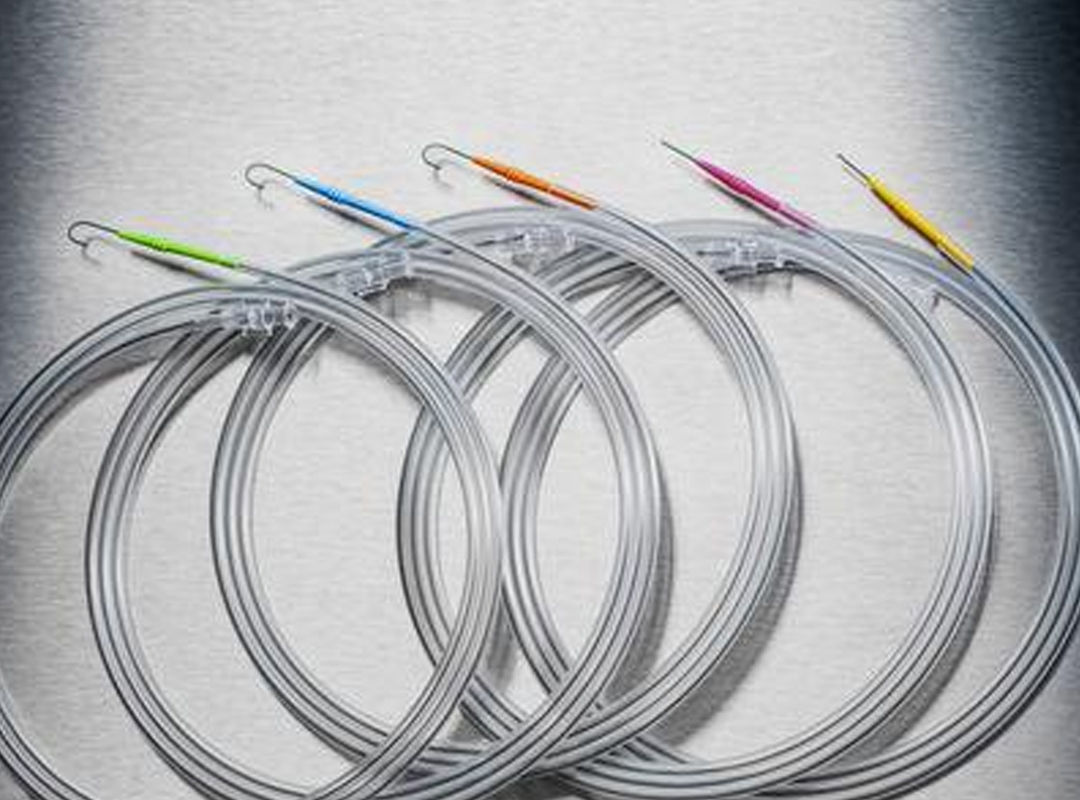
Produced with advanced wire drawing technology under rigorous quality control, our stainless steel wire achieves the extremely high standards of safety and reliability demanded in medical settings.
From selecting materials with excellent biocompatibility to optimizing wire characteristics for specific applications, we provide high-quality products as a partner supporting cutting-edge medical technology.
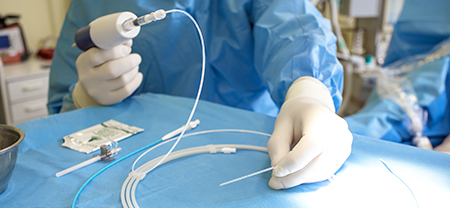
Acupuncture needle
Stainless steel wire for springs [JIS G4314]
Features
The mechanical properties of the product comply with JIS (Japanese Industrial Standards). The material used is wire rod that meets JIS G 4308 (chemical composition).
Specifications for Stainless Steel Wire for Springs
| Steel grade [JIS (SUS)] | 302、304、304N1、316 | 302、304、304N1 | 631J1 |
| Tempering | Type A (-WPA) | Type B (-WPB) | Type C (-WPC) |
| Wire diameter (mm) | Tensile strength (N/mm²) | ||
| 0.080~0.090 | 1650-1900 | 2150-2400 | - |
| 0.10~0.20 | 1950-2200 | ||
| 0.23~0.40 | 1600-1850 | 2050-2300 | 1930-2180 |
| 0.45~0.60 | 1950-2200 | 1850-2100 | |
| 0.65~1.00 | 1530-1780 | 1850-2100 | 1800-2050 |
| 1.20~1.40 | 1450-1700 | 1750-2000 | 1700-1950 |
| 1.60~2.00 | 1400-1650 | 1650-1900 | 1600-1850 |
| 2.30~2.60 | 1320-1570 | 1550-1800 | 1500-1750 |
| 2.90~4.00 | 1230-1480 | 1450-1700 | 1400-1650 |
| 4.50~6.00 | 1100-1350 | 1350-1600 | 1300-1550 |
| 6.50~8.00 | 1000-1250 | 1270-1520 | - |
| 9.00 | - | 1130-1380 | |
| 10.00 | 980-1230 | ||
| 12.00 | 880-1130 | ||
- *1)
- For SUS631J1-WPC, when tensile testing is performed on specimens after precipitation heat treatment (470±10°C, 1 hour heating followed by air cooling) as agreed between the parties involved in the delivery, the increase in tensile strength must be 250 N/mm² or greater.
- *2)
- The variation in tensile strength of a single coil shall, in principle, be within half the range of tensile strength specified in the table above.
- Note:
- For wire diameters in between, use the value of the larger diameter.
Wire diameter tolerance and eccentricity
| Wire diameter (mm) | JIS | WS, etc. | Palmos, etc. | |||
| Wire diameter tolerance (mm) | Eccentricity (mm) | Wire diameter tolerance (mm) | Eccentricity (mm) | Wire diameter tolerance (mm) | Eccentricity (mm) | |
| 0.080 | ±0.005 | Below 0.005 | -0.001、-0.003 | Below 0.001 | -0.001、-0.004 | Below 0.003 |
| 0.18 | ||||||
| 0.20 | -0.001、-0.004 | Below 0.002 | -0.001、-0.005 | Below 0.003 | ||
| 0.23 | ±0.008 | Below 0.008 | ||||
| 0.26 | ||||||
| 0.29 | -0.001、-0.005 | |||||
| 0.40 | ||||||
| 0.45 | ±0.010 | Below 0.010 | ||||
| 0.50 | -0.001、-0.007 | Below 0.005 | ||||
| 0.55 | -0.001、-0.007 | Below 0.003 | ||||
| 0.70 | ||||||
| 0.80 | -0.001、-0.008 | Below 0.004 | ||||
| 0.90 | ±0.015 | Below 0.015 | 0.000.、-0.015 | Below 0.007 | ||
| 1.00 | ||||||
| 1.20 | -0.001、-0.010 | Below 0.005 | ||||
| 1.40 | ||||||
| 1.60 | -0.001、-0.015 | Below 0.007 | ||||
| 1.80 | ±0.020 | Below 0.020 | ||||
| 2.00 | ||||||
| 2.30 | ±0.020 | Below 0.020 | ||||
| 3.20 | ||||||
| 3.50 | ±0.025 | Below 0.025 | ±0.015 | Below 0.015 | ±0.025 | Below 0.025 |
| 5.60 | ||||||
| 6.00 | ±0.020 | Below 0.020 | ||||
| 6.50 | ±0.035 | Below 0.035 | ±0.035 | Below 0.035 | ||
| 7.00 | ||||||
| 8.00 | ±0.030 | Below 0.030 | ||||
| 9.00 | ±0.035 | Below 0.035 | ||||
| 10.0 | ||||||
| 12.0 | ±0.050 | Below 0.050 | ±0.050 | Below 0.050 | ±0.050 | Below 0.050 |
- Note:
- For wire diameters in between, use the value of the larger diameter.
- *
- For special specification items, please contact us directly.
Straight stainless steel wire
Features
Straight stainless steel wire boasts excellent surface luster and superior straightness, eliminating the need for manual straightening and thereby improving work efficiency.
When used for torsion springs or forming processes, it enhances work efficiency and helps to ensure consistent quality.
Specifications for Stainless Steel Wire for Springs
| Wire diameter (mm) | Tensile strength (N/mm²) | Tolerance (mm) | Eccentricity (mm) | Straightness (mm) | |
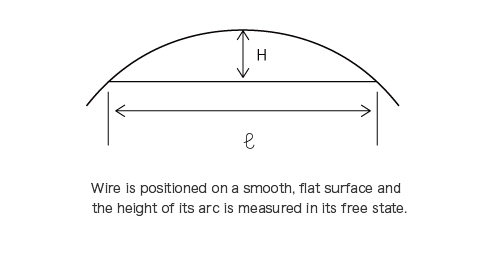
| SUS304-WPBS | Arc height H | Sample length ℓ | |||
| 0.20 | 2060-2400 | 0.005 -0.01 |
Below 0.010 | Below 2 | 100 |
| 0.23 | 2010-2300 | ||||
| 0.26 | 2010-2300 | Below 5 | 200 | ||
| 0.40 | 2010-2300 | ||||
| 0.45 | 1960-2260 | 0.007 -0.013 |
Below 0.013 | Below 4 | |
| 0.70 | 1910-2210 | ||||
| 0.90 | 1910-2210 | ||||
| 1.00 | 1910-2210 | 0.007 -0.015 |
Below 0.015 | ||
| 1.20 | 1910-2210 | ||||
- Note:
- For wire diameters in between, use the value of the larger diameter.
Figure: Straightness measurement method
Catheter
High-strength, high-torsion stainless steel wire
SSS304 US
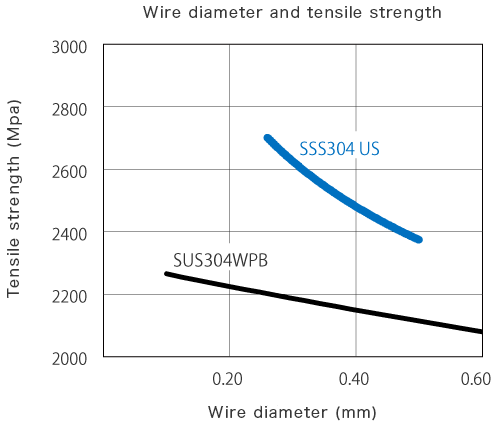
Suzuki-Sumiden Stainless SSS 304 US is a stainless steel wire that combines high strength with high torsion characteristics.
Characteristics
- Chemical composition:SUS304(JIS Spec)
- High strength (approximately 20% higher than SUS304WPB)
- High torsional properties (twist value approximately 30% higher than SUS304WPB)
Recommended applications
Medical applications (catheter guide wires, suture needles, etc.)
Manufacturing range
| Wire diameter (mm) | Tensile strength (Mpa) | Wire diameter tolerance deviation (mm) | |
| SSS304 US | Reference: SUS304-WPB | ||
| 0.25~0.28 | 2600~2900 | 2050~2300 | -0.001,-0.005≦0.003 |
| 0.29~0.34 | 2500~2800 | ||
| 0.35~0.39 | 2400~2700 | ||
| 0.40~0.44 | 2300~2600 | 1950~2200 | |
| 0.45~0.50 | 2250~2550 | -0.001,-0.007≦0.005 | |
Mechanical properties (torsional properties)
| Survey sample | Wire diameter (mm) | Tensile strength (Mpa) | Maximum torque (mN·m) | Twist value (100d, 120rpm) |
| ① SSS304 US | 0.35 | 2550 | 13.5 | 40 |
| ② SUS304 WPB | 2150 | 10.4 | 30 | |
| ③ Highly processed SUS304 (no special treatment) | 2500 | 11.7 | 13 |
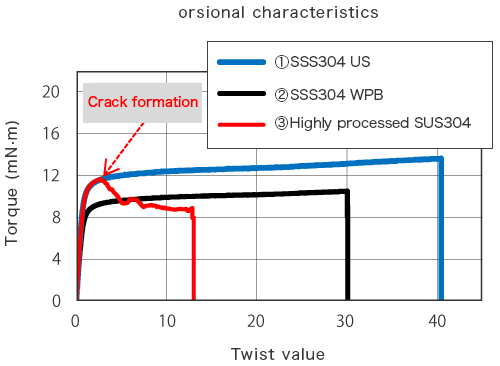
SSS304US exhibits superior torsional characteristics compared to SUS304WPB, featuring:
・Torque: Approximately 23% higher
・Torsion value: Approximately 30% higher
Normally, high strength and high torsional properties do not coexist, but through our unique processing, this product is able to achieve both of these characteristics.
Autoinjector
Stainless steel wire for high-strength springs EX-SUS
Characteristics
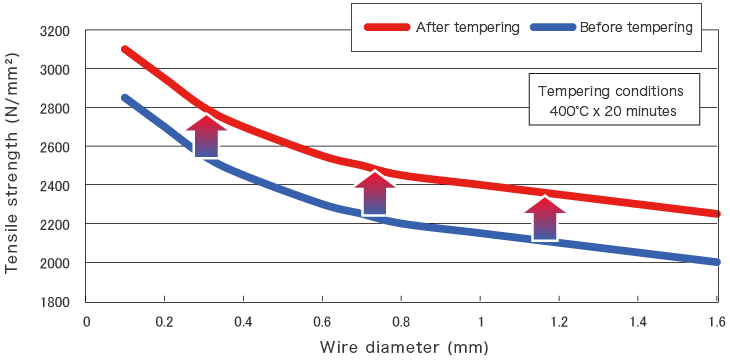
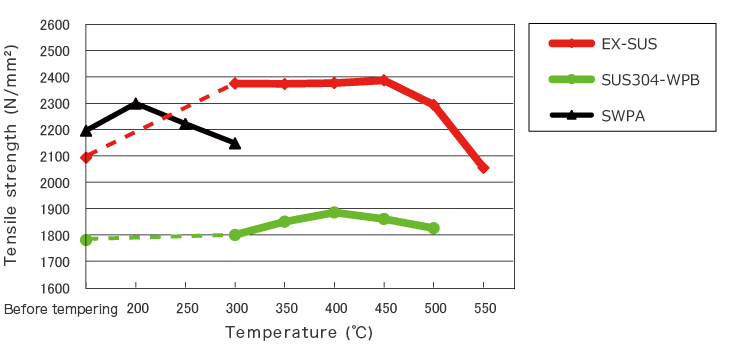
EX-SUS is a high-strength stainless steel wire for springs that achieves tensile strength equivalent to piano wire through low-temperature annealing (recommended: 400°C × 20 minutes).
| Steel grade | Wire diameter (mm) | Tensile strength (N/mm²) | 線径許容差(mm) | Eccentricity (mm) |
| EX-SUS | 0.10~0.12 | 2700-3000 | -0.001 -0.004 |
Below 0.003 |
| 0.14 | 2650-2950 | |||
| 0.16 | 2600-2900 | |||
| 0.18 | 2550-2850 | |||
| 0.20 | -0.001 -0.005 |
|||
| 0.23 | 2500-2800 | |||
| 0.26 | 2450-2750 | |||
| 0.29 | 2400-2700 | |||
| 0.35 | 2350-2650 | |||
| 0.40 | 2300-2600 | |||
| 0.45 | 2250-2550 | |||
| 0.50 | -0.001 -0.007 |
Below 0.005 | ||
| 0.55 | 2200-2450 | |||
| 0.65 | 2150-2400 | |||
| 0.70 | 2100-2350 | |||
| 0.80 | 2050-2300 | |||
| 0.90 | 0.000 -0.015 |
Below 0.007 | ||
| 1.00 | 2000-2250 | |||
| 1.20 | 1950-2200 | |||
| 1.40 | 1900-2150 | |||
| 1.60 | 1850-2100 | |||
| 1.80 | 1800-2050 | |||
| 2.00 | 1750-2000 | |||
| 2.60 | 1700-1950 | ±0.020 | Below 0.020 | |
| 2.90 | 1650-1900 | |||
| 3.20 | 1600-1850 | |||
| 3.50 | ±0.025 | Below 0.025 |
- Note:
- For wire diameters in between, use the value of the larger diameter.
Chemical composition
| Type symbols | Chemical composition(%) | |||||||
| C | Si | Mn | P | S | Ni | Cr | Others | |
| EX-SUS | ≦0.07 | ≦1.00 | 4.50-5.50 | ≦0.045 | ≦0.030 | 4.00-5.00 | 16.00-18.00 | Mo、N |
| SUS304 | ≦0.08 | ≦1.00 | ≦2.00 | ≦0.045 | ≦0.030 | 8.00-10.50 | 18.00-20.00 | - |
Changes in tensile strength due to annealing
Chemical composition
| Type symbols | Salt spray test | Pitting potential | ||
| Before tempering | After tempering | (V vs SCE) | ||
| EX-SUS | No rust | Slight rust | 0.47~0.53 | |
| SUS304-WPB | 0.43~0.45 | |||
- *
- Nickel-free plating (35℃ × 720 hours)
- (Same adjustment of sample surface)
Endoscope
Stainless steel wire for springs [JIS G4314]
Features
The mechanical properties of the product comply with JIS (Japanese Industrial Standards). The material used is wire rod that meets JIS G 4308 (chemical composition).
Specifications for Stainless Steel Wire for Springs
| Steel grade [JIS (SUS)] | 302、304、304N1、316 | 302、304、304N1 | 631J1 |
| Tempering | Type A (-WPA) | Type B (-WPB) | Type C (-WPC) |
| Wire diameter (mm) | Tensile strength (N/mm²) | ||
| 0.080~0.090 | 1650-1900 | 2150-2400 | - |
| 0.10~0.20 | 1950-2200 | ||
| 0.23~0.40 | 1600-1850 | 2050-2300 | 1930-2180 |
| 0.45~0.60 | 1950-2200 | 1850-2100 | |
| 0.65~1.00 | 1530-1780 | 1850-2100 | 1800-2050 |
| 1.20~1.40 | 1450-1700 | 1750-2000 | 1700-1950 |
| 1.60~2.00 | 1400-1650 | 1650-1900 | 1600-1850 |
| 2.30~2.60 | 1320-1570 | 1550-1800 | 1500-1750 |
| 2.90~4.00 | 1230-1480 | 1450-1700 | 1400-1650 |
| 4.50~6.00 | 1100-1350 | 1350-1600 | 1300-1550 |
| 6.50~8.00 | 1000-1250 | 1270-1520 | - |
| 9.00 | - | 1130-1380 | |
| 10.00 | 980-1230 | ||
| 12.00 | 880-1130 | ||
- *1)
- For SUS631J1-WPC, when tensile testing is performed on specimens after precipitation heat treatment (470±10°C, 1 hour heating followed by air cooling) as agreed between the parties involved in the delivery, the increase in tensile strength must be 250 N/mm² or greater.
- *2)
- The variation in tensile strength of a single coil shall, in principle, be within half the range of tensile strength specified in the table above.
- Note:
- For wire diameters in between, use the value of the larger diameter.
Wire diameter tolerance and eccentricity
| Wire diameter (mm) | JIS | WS, etc. | Palmos, etc. | |||
| Wire diameter tolerance (mm) | Eccentricity (mm) | Wire diameter tolerance (mm) | Eccentricity (mm) | Wire diameter tolerance (mm) | Eccentricity (mm) | |
| 0.080 | ±0.005 | Below 0.005 | -0.001、-0.003 | Below 0.001 | -0.001、-0.004 | Below 0.003 |
| 0.18 | ||||||
| 0.20 | -0.001、-0.004 | Below 0.002 | -0.001、-0.005 | Below 0.003 | ||
| 0.23 | ±0.008 | Below 0.008 | ||||
| 0.26 | ||||||
| 0.29 | -0.001、-0.005 | |||||
| 0.40 | ||||||
| 0.45 | ±0.010 | Below 0.010 | ||||
| 0.50 | -0.001、-0.007 | Below 0.005 | ||||
| 0.55 | -0.001、-0.007 | Below 0.003 | ||||
| 0.70 | ||||||
| 0.80 | -0.001、-0.008 | Below 0.004 | ||||
| 0.90 | ±0.015 | Below 0.015 | 0.000.、-0.015 | Below 0.007 | ||
| 1.00 | ||||||
| 1.20 | -0.001、-0.010 | Below 0.005 | ||||
| 1.40 | ||||||
| 1.60 | -0.001、-0.015 | Below 0.007 | ||||
| 1.80 | ±0.020 | Below 0.020 | ||||
| 2.00 | ||||||
| 2.30 | ±0.020 | Below 0.020 | ||||
| 3.20 | ||||||
| 3.50 | ±0.025 | Below 0.025 | ±0.015 | Below 0.015 | ±0.025 | Below 0.025 |
| 5.60 | ||||||
| 6.00 | ±0.020 | Below 0.020 | ||||
| 6.50 | ±0.035 | Below 0.035 | ±0.035 | Below 0.035 | ||
| 7.00 | ||||||
| 8.00 | ±0.030 | Below 0.030 | ||||
| 9.00 | ±0.035 | Below 0.035 | ||||
| 10.0 | ||||||
| 12.0 | ±0.050 | Below 0.050 | ±0.050 | Below 0.050 | ±0.050 | Below 0.050 |
- Note:
- For wire diameters in between, use the value of the larger diameter.
- *
- For special specification items, please contact us directly.
Straight stainless steel wire
Features
Straight stainless steel wire boasts excellent surface luster and superior straightness, eliminating the need for manual straightening and thereby improving work efficiency.
When used for torsion springs or forming processes, it enhances work efficiency and helps to ensure consistent quality.
Specifications for Stainless Steel Wire for Springs
| Wire diameter (mm) | Tensile strength (N/mm²) | Tolerance (mm) | Eccentricity (mm) | Straightness (mm) | |
| SUS304-WPBS | Arc height H | Sample length ℓ | |||
| 0.20 | 2060-2400 | 0.005 -0.01 |
Below 0.010 | Below 2 | 100 |
| 0.23 | 2010-2300 | ||||
| 0.26 | 2010-2300 | Below 5 | 200 | ||
| 0.40 | 2010-2300 | ||||
| 0.45 | 1960-2260 | 0.007 -0.013 |
Below 0.013 | Below 4 | |
| 0.70 | 1910-2210 | ||||
| 0.90 | 1910-2210 | ||||
| 1.00 | 1910-2210 | 0.007 -0.015 |
Below 0.015 | ||
| 1.20 | 1910-2210 | ||||
- Note:
- For wire diameters in between, use the value of the larger diameter.
Figure: Straightness measurement method
Inner needle
Stainless steel wire for springs [JIS G4314]
Features
The mechanical properties of the product comply with JIS (Japanese Industrial Standards). The material used is wire rod that meets JIS G 4308 (chemical composition).
Specifications for Stainless Steel Wire for Springs
| Steel grade [JIS (SUS)] | 302、304、304N1、316 | 302、304、304N1 | 631J1 |
| Tempering | Type A (-WPA) | Type B (-WPB) | Type C (-WPC) |
| Wire diameter (mm) | Tensile strength (N/mm²) | ||
| 0.080~0.090 | 1650-1900 | 2150-2400 | - |
| 0.10~0.20 | 1950-2200 | ||
| 0.23~0.40 | 1600-1850 | 2050-2300 | 1930-2180 |
| 0.45~0.60 | 1950-2200 | 1850-2100 | |
| 0.65~1.00 | 1530-1780 | 1850-2100 | 1800-2050 |
| 1.20~1.40 | 1450-1700 | 1750-2000 | 1700-1950 |
| 1.60~2.00 | 1400-1650 | 1650-1900 | 1600-1850 |
| 2.30~2.60 | 1320-1570 | 1550-1800 | 1500-1750 |
| 2.90~4.00 | 1230-1480 | 1450-1700 | 1400-1650 |
| 4.50~6.00 | 1100-1350 | 1350-1600 | 1300-1550 |
| 6.50~8.00 | 1000-1250 | 1270-1520 | - |
| 9.00 | - | 1130-1380 | |
| 10.00 | 980-1230 | ||
| 12.00 | 880-1130 | ||
- *1)
- For SUS631J1-WPC, when tensile testing is performed on specimens after precipitation heat treatment (470±10°C, 1 hour heating followed by air cooling) as agreed between the parties involved in the delivery, the increase in tensile strength must be 250 N/mm² or greater.
- *2)
- The variation in tensile strength of a single coil shall, in principle, be within half the range of tensile strength specified in the table above.
- Note:
- For wire diameters in between, use the value of the larger diameter.
Wire diameter tolerance and eccentricity
| Wire diameter (mm) | JIS | WS, etc. | Palmos, etc. | |||
| Wire diameter tolerance (mm) | Eccentricity (mm) | Wire diameter tolerance (mm) | Eccentricity (mm) | Wire diameter tolerance (mm) | Eccentricity (mm) | |
| 0.080 | ±0.005 | Below 0.005 | -0.001、-0.003 | Below 0.001 | -0.001、-0.004 | Below 0.003 |
| 0.18 | ||||||
| 0.20 | -0.001、-0.004 | Below 0.002 | -0.001、-0.005 | Below 0.003 | ||
| 0.23 | ±0.008 | Below 0.008 | ||||
| 0.26 | ||||||
| 0.29 | -0.001、-0.005 | |||||
| 0.40 | ||||||
| 0.45 | ±0.010 | Below 0.010 | ||||
| 0.50 | -0.001、-0.007 | Below 0.005 | ||||
| 0.55 | -0.001、-0.007 | Below 0.003 | ||||
| 0.70 | ||||||
| 0.80 | -0.001、-0.008 | Below 0.004 | ||||
| 0.90 | ±0.015 | Below 0.015 | 0.000.、-0.015 | Below 0.007 | ||
| 1.00 | ||||||
| 1.20 | -0.001、-0.010 | Below 0.005 | ||||
| 1.40 | ||||||
| 1.60 | -0.001、-0.015 | Below 0.007 | ||||
| 1.80 | ±0.020 | Below 0.020 | ||||
| 2.00 | ||||||
| 2.30 | ±0.020 | Below 0.020 | ||||
| 3.20 | ||||||
| 3.50 | ±0.025 | Below 0.025 | ±0.015 | Below 0.015 | ±0.025 | Below 0.025 |
| 5.60 | ||||||
| 6.00 | ±0.020 | Below 0.020 | ||||
| 6.50 | ±0.035 | Below 0.035 | ±0.035 | Below 0.035 | ||
| 7.00 | ||||||
| 8.00 | ±0.030 | Below 0.030 | ||||
| 9.00 | ±0.035 | Below 0.035 | ||||
| 10.0 | ||||||
| 12.0 | ±0.050 | Below 0.050 | ±0.050 | Below 0.050 | ±0.050 | Below 0.050 |
- Note:
- For wire diameters in between, use the value of the larger diameter.
- *
- For special specification items, please contact us directly.
Straight stainless steel wire
Features
Straight stainless steel wire boasts excellent surface luster and superior straightness, eliminating the need for manual straightening and thereby improving work efficiency.
When used for torsion springs or forming processes, it enhances work efficiency and helps to ensure consistent quality.
Specifications for Stainless Steel Wire for Springs
| Wire diameter (mm) | Tensile strength (N/mm²) | Tolerance (mm) | Eccentricity (mm) | Straightness (mm) | |
| SUS304-WPBS | Arc height H | Sample length ℓ | |||
| 0.20 | 2060-2400 | 0.005 -0.01 |
Below 0.010 | Below 2 | 100 |
| 0.23 | 2010-2300 | ||||
| 0.26 | 2010-2300 | Below 5 | 200 | ||
| 0.40 | 2010-2300 | ||||
| 0.45 | 1960-2260 | 0.007 -0.013 |
Below 0.013 | Below 4 | |
| 0.70 | 1910-2210 | ||||
| 0.90 | 1910-2210 | ||||
| 1.00 | 1910-2210 | 0.007 -0.015 |
Below 0.015 | ||
| 1.20 | 1910-2210 | ||||
- Note:
- For wire diameters in between, use the value of the larger diameter.
Figure: Straightness measurement method
Dental reamer
Stainless steel wire for springs [JIS G4314]
Features
The mechanical properties of the product comply with JIS (Japanese Industrial Standards). The material used is wire rod that meets JIS G 4308 (chemical composition).
Specifications for Stainless Steel Wire for Springs
| Steel grade [JIS (SUS)] | 302、304、304N1、316 | 302、304、304N1 | 631J1 |
| Tempering | Type A (-WPA) | Type B (-WPB) | Type C (-WPC) |
| Wire diameter (mm) | Tensile strength (N/mm²) | ||
| 0.080~0.090 | 1650-1900 | 2150-2400 | - |
| 0.10~0.20 | 1950-2200 | ||
| 0.23~0.40 | 1600-1850 | 2050-2300 | 1930-2180 |
| 0.45~0.60 | 1950-2200 | 1850-2100 | |
| 0.65~1.00 | 1530-1780 | 1850-2100 | 1800-2050 |
| 1.20~1.40 | 1450-1700 | 1750-2000 | 1700-1950 |
| 1.60~2.00 | 1400-1650 | 1650-1900 | 1600-1850 |
| 2.30~2.60 | 1320-1570 | 1550-1800 | 1500-1750 |
| 2.90~4.00 | 1230-1480 | 1450-1700 | 1400-1650 |
| 4.50~6.00 | 1100-1350 | 1350-1600 | 1300-1550 |
| 6.50~8.00 | 1000-1250 | 1270-1520 | - |
| 9.00 | - | 1130-1380 | |
| 10.00 | 980-1230 | ||
| 12.00 | 880-1130 | ||
- *1)
- For SUS631J1-WPC, when tensile testing is performed on specimens after precipitation heat treatment (470±10°C, 1 hour heating followed by air cooling) as agreed between the parties involved in the delivery, the increase in tensile strength must be 250 N/mm² or greater.
- *2)
- The variation in tensile strength of a single coil shall, in principle, be within half the range of tensile strength specified in the table above.
- Note:
- For wire diameters in between, use the value of the larger diameter.
Wire diameter tolerance and eccentricity
| Wire diameter (mm) | JIS | WS, etc. | Palmos, etc. | |||
| Wire diameter tolerance (mm) | Eccentricity (mm) | Wire diameter tolerance (mm) | Eccentricity (mm) | Wire diameter tolerance (mm) | Eccentricity (mm) | |
| 0.080 | ±0.005 | Below 0.005 | -0.001、-0.003 | Below 0.001 | -0.001、-0.004 | Below 0.003 |
| 0.18 | ||||||
| 0.20 | -0.001、-0.004 | Below 0.002 | -0.001、-0.005 | Below 0.003 | ||
| 0.23 | ±0.008 | Below 0.008 | ||||
| 0.26 | ||||||
| 0.29 | -0.001、-0.005 | |||||
| 0.40 | ||||||
| 0.45 | ±0.010 | Below 0.010 | ||||
| 0.50 | -0.001、-0.007 | Below 0.005 | ||||
| 0.55 | -0.001、-0.007 | Below 0.003 | ||||
| 0.70 | ||||||
| 0.80 | -0.001、-0.008 | Below 0.004 | ||||
| 0.90 | ±0.015 | Below 0.015 | 0.000.、-0.015 | Below 0.007 | ||
| 1.00 | ||||||
| 1.20 | -0.001、-0.010 | Below 0.005 | ||||
| 1.40 | ||||||
| 1.60 | -0.001、-0.015 | Below 0.007 | ||||
| 1.80 | ±0.020 | Below 0.020 | ||||
| 2.00 | ||||||
| 2.30 | ±0.020 | Below 0.020 | ||||
| 3.20 | ||||||
| 3.50 | ±0.025 | Below 0.025 | ±0.015 | Below 0.015 | ±0.025 | Below 0.025 |
| 5.60 | ||||||
| 6.00 | ±0.020 | Below 0.020 | ||||
| 6.50 | ±0.035 | Below 0.035 | ±0.035 | Below 0.035 | ||
| 7.00 | ||||||
| 8.00 | ±0.030 | Below 0.030 | ||||
| 9.00 | ±0.035 | Below 0.035 | ||||
| 10.0 | ||||||
| 12.0 | ±0.050 | Below 0.050 | ±0.050 | Below 0.050 | ±0.050 | Below 0.050 |
- Note:
- For wire diameters in between, use the value of the larger diameter.
- *
- For special specification items, please contact us directly.
Straight stainless steel wire
Features
Straight stainless steel wire boasts excellent surface luster and superior straightness, eliminating the need for manual straightening and thereby improving work efficiency.
When used for torsion springs or forming processes, it enhances work efficiency and helps to ensure consistent quality.
Specifications for Stainless Steel Wire for Springs
| Wire diameter (mm) | Tensile strength (N/mm²) | Tolerance (mm) | Eccentricity (mm) | Straightness (mm) | |
| SUS304-WPBS | Arc height H | Sample length ℓ | |||
| 0.20 | 2060-2400 | 0.005 -0.01 |
Below 0.010 | Below 2 | 100 |
| 0.23 | 2010-2300 | ||||
| 0.26 | 2010-2300 | Below 5 | 200 | ||
| 0.40 | 2010-2300 | ||||
| 0.45 | 1960-2260 | 0.007 -0.013 |
Below 0.013 | Below 4 | |
| 0.70 | 1910-2210 | ||||
| 0.90 | 1910-2210 | ||||
| 1.00 | 1910-2210 | 0.007 -0.015 |
Below 0.015 | ||
| 1.20 | 1910-2210 | ||||
- Note:
- For wire diameters in between, use the value of the larger diameter.
Figure: Straightness measurement method
Ophthalmic scalpel
Stainless steel wire for springs [JIS G4314]
Features
The mechanical properties of the product comply with JIS (Japanese Industrial Standards). The material used is wire rod that meets JIS G 4308 (chemical composition).
Specifications for Stainless Steel Wire for Springs
| Steel grade [JIS (SUS)] | 302、304、304N1、316 | 302、304、304N1 | 631J1 |
| Tempering | Type A (-WPA) | Type B (-WPB) | Type C (-WPC) |
| Wire diameter (mm) | Tensile strength (N/mm²) | ||
| 0.080~0.090 | 1650-1900 | 2150-2400 | - |
| 0.10~0.20 | 1950-2200 | ||
| 0.23~0.40 | 1600-1850 | 2050-2300 | 1930-2180 |
| 0.45~0.60 | 1950-2200 | 1850-2100 | |
| 0.65~1.00 | 1530-1780 | 1850-2100 | 1800-2050 |
| 1.20~1.40 | 1450-1700 | 1750-2000 | 1700-1950 |
| 1.60~2.00 | 1400-1650 | 1650-1900 | 1600-1850 |
| 2.30~2.60 | 1320-1570 | 1550-1800 | 1500-1750 |
| 2.90~4.00 | 1230-1480 | 1450-1700 | 1400-1650 |
| 4.50~6.00 | 1100-1350 | 1350-1600 | 1300-1550 |
| 6.50~8.00 | 1000-1250 | 1270-1520 | - |
| 9.00 | - | 1130-1380 | |
| 10.00 | 980-1230 | ||
| 12.00 | 880-1130 | ||
- *1)
- For SUS631J1-WPC, when tensile testing is performed on specimens after precipitation heat treatment (470±10°C, 1 hour heating followed by air cooling) as agreed between the parties involved in the delivery, the increase in tensile strength must be 250 N/mm² or greater.
- *2)
- The variation in tensile strength of a single coil shall, in principle, be within half the range of tensile strength specified in the table above.
- Note:
- For wire diameters in between, use the value of the larger diameter.
Wire diameter tolerance and eccentricity
| Wire diameter (mm) | JIS | WS, etc. | Palmos, etc. | |||
| Wire diameter tolerance (mm) | Eccentricity (mm) | Wire diameter tolerance (mm) | Eccentricity (mm) | Wire diameter tolerance (mm) | Eccentricity (mm) | |
| 0.080 | ±0.005 | Below 0.005 | -0.001、-0.003 | Below 0.001 | -0.001、-0.004 | Below 0.003 |
| 0.18 | ||||||
| 0.20 | -0.001、-0.004 | Below 0.002 | -0.001、-0.005 | Below 0.003 | ||
| 0.23 | ±0.008 | Below 0.008 | ||||
| 0.26 | ||||||
| 0.29 | -0.001、-0.005 | |||||
| 0.40 | ||||||
| 0.45 | ±0.010 | Below 0.010 | ||||
| 0.50 | -0.001、-0.007 | Below 0.005 | ||||
| 0.55 | -0.001、-0.007 | Below 0.003 | ||||
| 0.70 | ||||||
| 0.80 | -0.001、-0.008 | Below 0.004 | ||||
| 0.90 | ±0.015 | Below 0.015 | 0.000.、-0.015 | Below 0.007 | ||
| 1.00 | ||||||
| 1.20 | -0.001、-0.010 | Below 0.005 | ||||
| 1.40 | ||||||
| 1.60 | -0.001、-0.015 | Below 0.007 | ||||
| 1.80 | ±0.020 | Below 0.020 | ||||
| 2.00 | ||||||
| 2.30 | ±0.020 | Below 0.020 | ||||
| 3.20 | ||||||
| 3.50 | ±0.025 | Below 0.025 | ±0.015 | Below 0.015 | ±0.025 | Below 0.025 |
| 5.60 | ||||||
| 6.00 | ±0.020 | Below 0.020 | ||||
| 6.50 | ±0.035 | Below 0.035 | ±0.035 | Below 0.035 | ||
| 7.00 | ||||||
| 8.00 | ±0.030 | Below 0.030 | ||||
| 9.00 | ±0.035 | Below 0.035 | ||||
| 10.0 | ||||||
| 12.0 | ±0.050 | Below 0.050 | ±0.050 | Below 0.050 | ±0.050 | Below 0.050 |
- Note:
- For wire diameters in between, use the value of the larger diameter.
- *
- For special specification items, please contact us directly.
Straight stainless steel wire
Features
Straight stainless steel wire boasts excellent surface luster and superior straightness, eliminating the need for manual straightening and thereby improving work efficiency.
When used for torsion springs or forming processes, it enhances work efficiency and helps to ensure consistent quality.
Specifications for Stainless Steel Wire for Springs
| Wire diameter (mm) | Tensile strength (N/mm²) | Tolerance (mm) | Eccentricity (mm) | Straightness (mm) | |
| SUS304-WPBS | Arc height H | Sample length ℓ | |||
| 0.20 | 2060-2400 | 0.005 -0.01 |
Below 0.010 | Below 2 | 100 |
| 0.23 | 2010-2300 | ||||
| 0.26 | 2010-2300 | Below 5 | 200 | ||
| 0.40 | 2010-2300 | ||||
| 0.45 | 1960-2260 | 0.007 -0.013 |
Below 0.013 | Below 4 | |
| 0.70 | 1910-2210 | ||||
| 0.90 | 1910-2210 | ||||
| 1.00 | 1910-2210 | 0.007 -0.015 |
Below 0.015 | ||
| 1.20 | 1910-2210 | ||||
- Note:
- For wire diameters in between, use the value of the larger diameter.
Figure: Straightness measurement method
Suture needle
Stainless steel wire for springs [JIS G4314]
Features
The mechanical properties of the product comply with JIS (Japanese Industrial Standards). The material used is wire rod that meets JIS G 4308 (chemical composition).
Specifications for Stainless Steel Wire for Springs
| Steel grade [JIS (SUS)] | 302、304、304N1、316 | 302、304、304N1 | 631J1 |
| Tempering | Type A (-WPA) | Type B (-WPB) | Type C (-WPC) |
| Wire diameter (mm) | Tensile strength (N/mm²) | ||
| 0.080~0.090 | 1650-1900 | 2150-2400 | - |
| 0.10~0.20 | 1950-2200 | ||
| 0.23~0.40 | 1600-1850 | 2050-2300 | 1930-2180 |
| 0.45~0.60 | 1950-2200 | 1850-2100 | |
| 0.65~1.00 | 1530-1780 | 1850-2100 | 1800-2050 |
| 1.20~1.40 | 1450-1700 | 1750-2000 | 1700-1950 |
| 1.60~2.00 | 1400-1650 | 1650-1900 | 1600-1850 |
| 2.30~2.60 | 1320-1570 | 1550-1800 | 1500-1750 |
| 2.90~4.00 | 1230-1480 | 1450-1700 | 1400-1650 |
| 4.50~6.00 | 1100-1350 | 1350-1600 | 1300-1550 |
| 6.50~8.00 | 1000-1250 | 1270-1520 | - |
| 9.00 | - | 1130-1380 | |
| 10.00 | 980-1230 | ||
| 12.00 | 880-1130 | ||
- *1)
- For SUS631J1-WPC, when tensile testing is performed on specimens after precipitation heat treatment (470±10°C, 1 hour heating followed by air cooling) as agreed between the parties involved in the delivery, the increase in tensile strength must be 250 N/mm² or greater.
- *2)
- The variation in tensile strength of a single coil shall, in principle, be within half the range of tensile strength specified in the table above.
- Note:
- For wire diameters in between, use the value of the larger diameter.
Wire diameter tolerance and eccentricity
| Wire diameter (mm) | JIS | WS, etc. | Palmos, etc. | |||
| Wire diameter tolerance (mm) | Eccentricity (mm) | Wire diameter tolerance (mm) | Eccentricity (mm) | Wire diameter tolerance (mm) | Eccentricity (mm) | |
| 0.080 | ±0.005 | Below 0.005 | -0.001、-0.003 | Below 0.001 | -0.001、-0.004 | Below 0.003 |
| 0.18 | ||||||
| 0.20 | -0.001、-0.004 | Below 0.002 | -0.001、-0.005 | Below 0.003 | ||
| 0.23 | ±0.008 | Below 0.008 | ||||
| 0.26 | ||||||
| 0.29 | -0.001、-0.005 | |||||
| 0.40 | ||||||
| 0.45 | ±0.010 | Below 0.010 | ||||
| 0.50 | -0.001、-0.007 | Below 0.005 | ||||
| 0.55 | -0.001、-0.007 | Below 0.003 | ||||
| 0.70 | ||||||
| 0.80 | -0.001、-0.008 | Below 0.004 | ||||
| 0.90 | ±0.015 | Below 0.015 | 0.000.、-0.015 | Below 0.007 | ||
| 1.00 | ||||||
| 1.20 | -0.001、-0.010 | Below 0.005 | ||||
| 1.40 | ||||||
| 1.60 | -0.001、-0.015 | Below 0.007 | ||||
| 1.80 | ±0.020 | Below 0.020 | ||||
| 2.00 | ||||||
| 2.30 | ±0.020 | Below 0.020 | ||||
| 3.20 | ||||||
| 3.50 | ±0.025 | Below 0.025 | ±0.015 | Below 0.015 | ±0.025 | Below 0.025 |
| 5.60 | ||||||
| 6.00 | ±0.020 | Below 0.020 | ||||
| 6.50 | ±0.035 | Below 0.035 | ±0.035 | Below 0.035 | ||
| 7.00 | ||||||
| 8.00 | ±0.030 | Below 0.030 | ||||
| 9.00 | ±0.035 | Below 0.035 | ||||
| 10.0 | ||||||
| 12.0 | ±0.050 | Below 0.050 | ±0.050 | Below 0.050 | ±0.050 | Below 0.050 |
- Note:
- For wire diameters in between, use the value of the larger diameter.
- *
- For special specification items, please contact us directly.
Straight stainless steel wire
Features
Straight stainless steel wire boasts excellent surface luster and superior straightness, eliminating the need for manual straightening and thereby improving work efficiency.
When used for torsion springs or forming processes, it enhances work efficiency and helps to ensure consistent quality.
Specifications for Stainless Steel Wire for Springs
| Wire diameter (mm) | Tensile strength (N/mm²) | Tolerance (mm) | Eccentricity (mm) | Straightness (mm) | |
| SUS304-WPBS | Arc height H | Sample length ℓ | |||
| 0.20 | 2060-2400 | 0.005 -0.01 |
Below 0.010 | Below 2 | 100 |
| 0.23 | 2010-2300 | ||||
| 0.26 | 2010-2300 | Below 5 | 200 | ||
| 0.40 | 2010-2300 | ||||
| 0.45 | 1960-2260 | 0.007 -0.013 |
Below 0.013 | Below 4 | |
| 0.70 | 1910-2210 | ||||
| 0.90 | 1910-2210 | ||||
| 1.00 | 1910-2210 | 0.007 -0.015 |
Below 0.015 | ||
| 1.20 | 1910-2210 | ||||
- Note:
- For wire diameters in between, use the value of the larger diameter.
Figure: Straightness measurement method
